An Introduction to the Great Issac Newton

Issac Newton was the greatest scientist of the 17th Century. He was famous for his discoveries in physics such as Newton's three Laws of Motion, which have become the foundations of physics to this day. He also discovered the concept of gravity. From my perspective, he was not only a great physician, astronomer, but also a great mathematician..
Early Life of Issac Newton

Newton was born on Christmas Day, December 25th, 1642. The place he born was a very small town by Lincolnshrire county in England. His father was also named Issac Newton, but died three month before he was born. His family was not rich, he made an effort to be admitted to Cambridge University in 1661 with reduced tuition fees. He won the scholarship in 1664 in Cambridge University. And he was elected as a fellow trinity in 1667 at the time he was back to Cambridge University.

After 2 years of study, Newton impressed the Professor Isaac Barrow, who is the current professor at that time in Cambridge University, who had the esteemed Lucasian professorship at Cambridge University. Newton had later been chosen as Barrow's successful for this professorship. At that time, he was only 26 years old. He also received his MA, and elected as a Fellow of Royal Society in 1672.
Newton's General Discoveries
Newton discovered a lot of topics related to Physics, Astronomy, and Mathematics. His theory related to optics states that white light was a composite of all colors of the spectrum, and he also claimed that light was composed by a lot of particles. He came with the ideas of law of motion and theory of gravity and those concepts are still the most important fundamental concepts in physics area until now.
In Mathematical field, he developed a lot of idea in higher mathematical areas, like the important idea of calculus. He also discovered other mathematical concepts such as product rule, chain rule, Taylor series, but he didn't publish those concepts in public.
From my perspective, I believed that Newton was the greatest mathematical in the past, even if his concepts in physics and astronomy area are really shiny. The reason is he used the idea he invented in Calculus to complete a lot of proves in Physics area, which was include in his publish "Philosophiæ Naturalis Principia Mathematic". His achievement in mathematical area are fundamental, a lot of physicians and mathematicians invented more concepts are based on his discoveries, which include Albert Einstein.
Advances in calculus (left) helped Isaac Newton formulate a new understanding of how objects in the natural world move.
Newton's discovery of calculus led a convenient way for other mathematicians to solve lots of problems. His work in optics included both the discovery of white light and the color spectrum. This discovery made him to be well known in that time.

Newton's Concept in Calculus
From1665-1666, the Britain has suffered from the great plague. By the time, Newton discovered gravity, developed a new theory of optics, and create a novel approach to mathematics which is called Calculus. His theory of calculus built on earlier work by his fellow Englishmen Isaac Barrow, the man we have mentioned in his early life. He also worked based on some other great mathematicians as René Descartes, Pierre de Fermat, and Gilles Personne de Roberval. His discovery on calculus helped the subsequent mathematicians and engineers to understand the motion and dynamic change in everywhere inside or even outside of the earth, such as the motion of fluids, the orbits of planets, etc.

Differentiation (derivative) approximates the slope of a curve as the interval approaches zero(see right image)
Newton started his research in Calculus at the same time of Gottfried Wilhelm Leibniz started his own work on Calculus. But Newton was more focused on the motion part of the Calculus while Leibniz was more concerned on geometry part. There were a lot of dispute of priority of calculus between Leibniz and Newton for their discoveries. Most modern historians believed that there was not no priority issues on Calculus since Newton and Leibniz were worked independently, they were just using different notations. Newton didn't publish any of his discoveries on Calculus until 1693, it was because he thought his ideas may suffered from many argument and critics, the most recent record was found on 1704. The idea was not written in the Calculus notation as we know from today but Newton used a dot notation. In his principle ideas of Calculus, Newton gave demonstration of this under the name of 'the method of first and last ratios, that's why his theory was called as the infinitesimal calculus in modern times.

Integration approximates the area under a curve as the size of the samples approaches zero
From 1699, the Royal Society of London believed that Newton's work on Calculus has been plagiarized by Leibniz. But the disputation was doubt when it was later found that Newton wrote the study's concluding remarks on Leibniz. "Thus began the bitter controversy which marred the lives of both Newton and Leibniz until the latter's death in 1716."( Ball 1908, pp. 356ff.)
Newton and Royal Society of London

Moreover, Newton also published the "Methodus Fluxionum et Serierum Infinitarum. He stated the idea that the point of f'(x) = 0 is the extrema of the f(x). And he listed how to use this method to solve nine geometry problems. The appearance of "Fluxion" has created a diverse aspect of Mathematics besides Geometry and Algebra, which is Mathematical Analysis. Newton treated that as the analysis based on infinite multiple function, and it developed into differential geometry and differential equations. Those ideas accelerated the development of Physics.
Newton's Idea of Fluid Mechanics

Newton pointed out that the viscous fluid resistance is proportional to the shear rate. He stated that the resistance due to the lack of lubricity between the fluid parts. If everything else is the same,then it is proportional to the speed of separation between the fluid parts. The fluids that meet this law are now called Newtonian fluids, which include the most common fluid like water and air, and non-Newtonian fluids that do not follow to this rule.
Given the resistance of the flat plate to the airflow, Newton uses a particle model for the gas and concludes that the resistance is proportional to the sine square of the angle of attack. This conclusion is not correct in general, but due to Newton's authority, later generations have long been a creed. In the 20th century, when T. Carmen summarized the development of aerodynamics, he humorously stated that Newton had made the aircraft invention a century late.
With regard to the speed of sound, Newton correctly stated that the speed of sound is proportional to the square root of atmospheric pressure and inversely proportional to the square root of density. However, because he considered acoustic propagation as an isotherm process, the results were inconsistent with reality.
Conclusion
The era in that Newton (1643-1727) was born was an era of great changes in European society. The emancipation of the mind and the enlightenment of ideas brought about by the Renaissance of the 14th and 16th centuries brought unprecedented prosperity to the European spiritual culture, and the natural sciences gained new life and thrived. The British bourgeois revolution is booming.
In 17th century's Europe, people began to conduct scientific research on mechanical phenomena and conducted accurate research. Many physicists and astronomers such as Copernicus, Bruno, Galileo, and Kepler have done a lot of arduous work, and classical mechanics gradually got rid of the shackles of traditional concepts and made great progress.
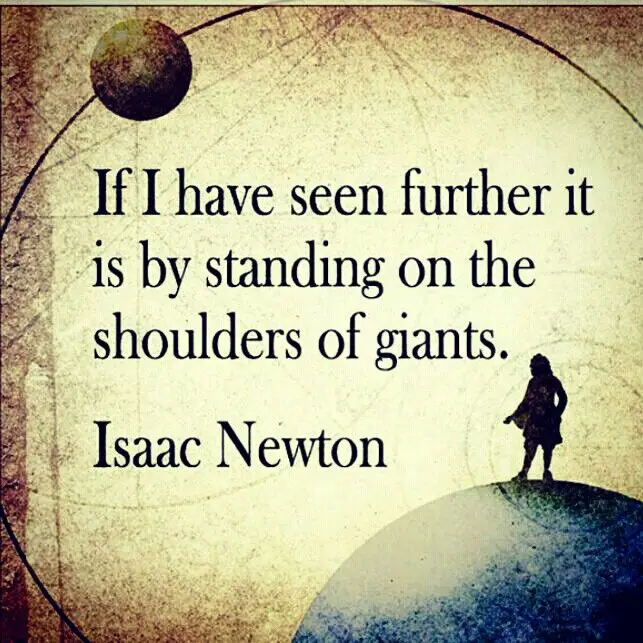
British scientists Newton based on previous research and practice, after long-term experimental observations, mathematical calculations and in-depth thinking, put forward the three laws of mechanics and the law of universal gravitation, unified the mechanics of celestial bodies and the mechanics of objects on the earth, and established a new system, the classical mechanics theory. The idea of classical mechanics was constructed by Galileo and the best physicists of his time, and was formally established by Newton. So Newton once said that he was standing on the shoulders of the giant.
Reference
1. 17TH CENTURY MATHEMATICS NEWTON, http://www.storyofmathematics.com/17th_newton.html
2. Bardi, Jason Socrates. The Calculus Wars: Newton, Leibniz, and the Greatest Mathematical Clash of All Time (2006)
3. Bechler, Zev (1991). Newton's Physics and the Conceptual Structure of the Scientific Revolution. Springer
4. Casini, P (1988). "Newton's Principia and the Philosophers of the Enlightenment". Notes and Records of the Royal Society of London. 42 (1): 35–52.
5. Hawking, Stephen, ed. On the Shoulders of Giants.
6. Christianson, Gale (1984). In the Presence of the Creator: Isaac Newton & His Times. New York: Free Press.
Comments
Post a Comment